|
 |
 |
Culture Courses
1 Dough figurine
The dough figurine, also called the Flour Doll, or Flour Sculpture, is a simple but highly artistic Chinese folk handicraft, whose history dates back 4,000 years. With wheat flour and glutinous rice flour as the main materials, together with mineral pigment, glycerine, bee-honey, and antiseptic (to make the finished figurines durable), a colourful dough is first made, which is well kneaded and later magically and skillfully turned into various lovely figurines, held by many as popular artistic creations. |
2 Chinese painting
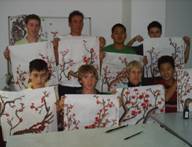
The origins of traditional Chinese painting reach far back into China's history. Works dating from before the Tang Dynasty (618-907 A.D.) are mainly line drawings of people engaged in various activities; this was the "golden age" of human figure drawing. By the mid-Tang Dynasty, landscape and flower-and-bird paintings began their rise to prominence. Paintings of mountains, forests, fields, and gardens have the ability to transport one away from the vexations of the material world into a peaceful, carefree realm. Because of this, landscape paintings have always been highly regarded by China's literati and officialdom. The flowers, grass, trees, stones, and birds depicted in the lively and energetic flower-and-bird paintings are also widely admired. Thus the landscape and flower-and-bird types of painting, together with the earlier human figure painting, comprise the three main categories of traditional Chinese painting.
Landscape paintings, although emerged late, experienced fast development, forming different styles, including "blue-and-green" landscapes (青綠山水) and "ink-and-wash" landscapes (水墨山水) etc. |
3 Traditional folk toy – Chinese Diabolo
The Chinese Diabolo, literally “hollow bamboo”, is made from bamboo and has a hollow centre, giving rise to its Chinese name. In China, it is not only a popular game but also a healthy sport activity and acrobatic performance.
Chinese Diabolo is the eastern counterpart to the western yoyo. So it is also often called Chinese yoyo. It is a traditional Chinese toy consisting of a spool which is whirled and tossed on a string tied to two sticks one held in each hand. Some Chinese Diabolos are designed to make a whistling sound when spinning at high speed. They are often used in acrobatic or Chinese ethnic dance performances. The performances of Chinese yoyos are often considered a form of juggling. A huge variety of tricks is possible using the sticks, string, and various body parts. e.g., multiple diabolos can be spun on a single string. |
4 Chinese calligraphy
Chinese calligraphy is like a rare, exotic flower in the history of civilization, and is a unique gem of oriental culture. For the Chinese, calligraphy, the ancient art of the written word, is not just a method of communication but also a means of expressing the dynamic forces of the natural world. Graphically, it is comparable to painting in its ability to evoke emotion through a rich variety of form and design. As abstract art, it displays the rhythmic and harmonious flow of music. And from a practical point of view, it is written language.
By controlling the concentration of ink, the thickness and absorption of the paper, and the flexibility of the brush, the artist is free to produce an infinite variety of styles and forms, reflecting his or her personality, discipline, patience, and persistence.
Many styles of Chinese calligraphic writing have developed over the centuries, such as zhuanshu (篆書, seal-script), caoshu (草書, grass script), lishu (隸書, official script) and kaishu (楷書, standard script) etc. |
5 Tai chi chuan ( Chinese shadowboxing )
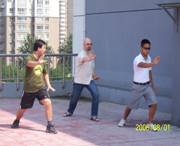
Chinese shadowboxing, also commonly known as Tai Chi, or Taiji, is both an internal Chinese martial art and a fitness routine. Tai Chi theory and practice was formulated in agreement with many of the principles of traditional Chinese medicine, philosophy, and aesthetics.
By learning and practicing Taiji, you will figure out more and more of its advantages, which will benefit you for your whole life. |
6 Making Kites
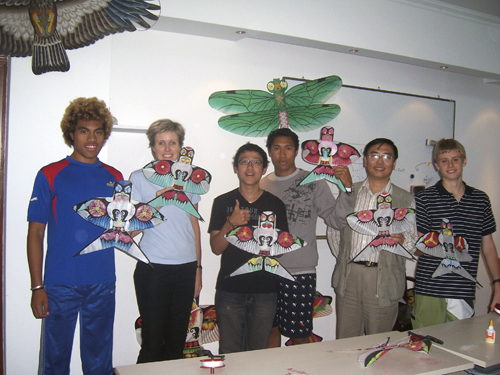
The kite, a Chinese invention with a long history, is mainly, but not only, a plaything. It has contributed to science and production. It has been praised as the forerunner of the modern aeroplane, and has been recorded in <SCIENCE AND CIVILIZATION IN CHINA> by English scientist Joseph Needham, together with the four great inventions.
The four steps in making a kite are themselves highly artistic: making the frame with bamboo strips; covering the frame using paper or silk; painting the kite with colors or a message; and finally, flying the kite.
Flying a kite you have made yourself is definitely an enjoyable experience. |
7 Drawing a Beijing Opera mask
Beijing Opera (aka Peking Opera) has existed for more than 200 years. It is widely regarded as the highest expression of Chinese culture and has finally emerged as the national standard.
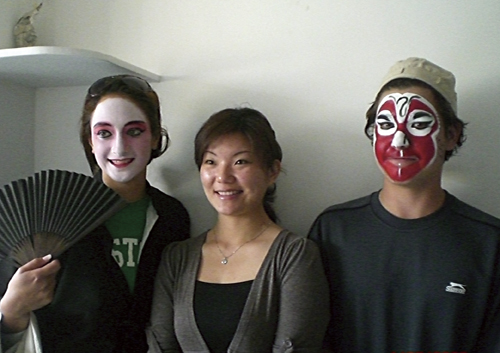
The Beijing Opera mask, the elaborate face painting in Beijing Opera, is an art unto itself. Each painted mask is a representation of particular qualities of character. By studying the particular qualities, students can appreciate the beauty of the mask, getting a deeper understanding of Chinese traditional art and culture. In addition, the strong, expressive power coming from the point, pattern and colour in the mask can lead students to create their own masks with specific personalities. |
8 Chinese Knot
The Chinese Knot or Chinese traditional decorating knot is a kind of characteristic folk decoration or handicraft art. Appearing in ancient times, developed in the Tang and Song dynasties (960-1229A.D.) and popularized in the Ming and Qing dynasties (1368-1911A.D.), the Chinese Knot has now become a kind of elegant and colorful art and craft, but it was originally developed for practical use.
The characteristic of the Chinese Knot is that every one is made of a single rope and named by its specific form and meaning. By combining different knots or other auspicious adornments skillfully, a unique auspicious ornament which represents beauty, ideas and wishes is formed. |
9 Chinese paper cutting
Papercutting is one of China's most popular folkarts, which can be found in most parts of China, with distinctive types and characteristics.
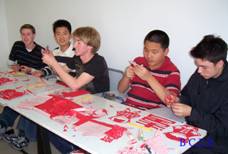
Papercuttings are used for both religious and decorative purposes, which not only reflect the Chinese people’s aesthetic tastes , but also their hope and wishes for comfort, auspiciousness and happiness. |
10 Chinese tea lore
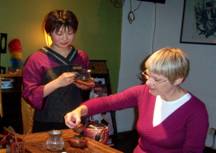
Tea lore belongs to oriental culture. Tea was historically regarded bytea lovers as a precious and noble drink, and tea tasting was both an intellectual enjoyment and means of cultivating moral character and nature. In Chinese tea lore, by going through the tea tasting process, an individual’s moral character is enlightened and enhanced, achieving harmony in the human mind.
|
11 Making jiaozi (Chinese Dumpling)
Jiaozi or Chinese dumplings are a traditional and popularfood in China with a history of more than 1,000 years. Jiaozi is a traditional Spring Festival dish and adorns dinner tables across the country during this season. The typical Jiaozi has a meat and vegetable filling covered by a wheat-flour wrapper and can be boiled or steamed.
In China, Jiaozi have special cultural meanings, bearing both the Chinese people’s warm memories from the bottom of their hearts, and also their wishes for a better future. |
12 Making zongzi
The Zongzi is a traditional food of the Chinese people. Legend says it was invented to commemorate the suicidal great patriot poet, Qu Yuan. Eating zongzi during Dragon Boat Festival (5th day of the 5th lunar month) remains a traditional custom.
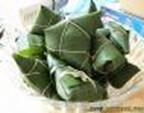
The Zongzi is a special kind of dumpling. It is usually made of glutinous rice wrapped in bamboo leaves with triangular or pyramidal shapes. The main fillings include dates and sweetened bean paste. South china people also use meat, ham, yolk of egg, etc.
What a great form of spiritual enjoyment, to make your own zongzi and then, in the fresh smell of bamboo leaves, experience Chinese history and culture. |
13 Make tangyuan
It is an important custom for Chinese people to eat tangyuan or rice dumplings, at The Lantern Festival, which is on the 15th day of the 1st lunar month. Tangyuan, also named Yuanxiao, are small sweet dumpling balls made of glutinous rice flour with rose petals, sesame, bean paste etc as filling. What's more, tangyuan in Chinese has a similar pronunciation to "tuanyuan”, meaning reunion. So people eat them to denote union, harmony and happiness for the family. |
14 Mahjong
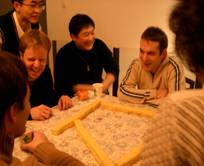
Mahjong, originated in China approximately 3,000 years ago, was originally a game played only by emperors and aristocrats. Later it spread to grassroots society and became well accepted in the Qing Dynasty. As an important part of Chinese traditional culture, the game is characterized by its integration of skill, strategy, intelligence, calculation and even luck. For hundreds of years, the game has been enjoyed by all walks of life, throughout Asia and the world, becoming the most influential intelligent game among Chinese people. |
15 Chinese Acupuncture
Acupuncture is one of China’s characteristic illness treatment approaches.
Very basically, acupuncture is the insertion of very fine needles, (sometimes in conjunction with electrical stimulus), on the body's surface, in order to influence physiological functioning of the body and therefore according to Meridians’ (or Chinese Channels) theory, treat or prevent disease.
The first record of acupuncture is found in the 4,700 years old Huang Di Nei Jing <Yellow Emperor's Classic of Internal Medicine>, which is said to be the oldest medical textbook in the world. Acupuncture has been popular in China and even spread to the outside world since then. |
16 Tuina
Tuina is a treatment approach where massage is given in the Chinese way. The term "Tuina" translates into "push-grasp" in English. Physically, it is a series of pressing, tapping, and kneading actions that removes blockages along the meridians of the body and stimulates the flow of blood to treat or prevent illness. This is an ideal alternative to the modern drug-based and chemical-based treatments, but unlike drug and chemical based treatments, has no side effects. |
17 Chinese Cupping therapy
Cupping is a commonly practiced Chinese medicine treatment. This is a method of stimulating hurting points by applying suction through a metal, wood or glass jar, in which a partial vacuum has been created. This technique helps balance yin-yang throughout the body, therefore relieving pain and fatigue, preventing and treating illness. There are many diseases that can be treated successfully by Chinese cupping, such as low back pain.
|
|
|